On December 13 we launched a HAB balloon in coordination with a NoiseBridge meshtastic HAB launch. For the highest probability of a balloon recovery, using the amateur.sondehub.org predicted flight path, a park in Stockton was selected as the launch site. This placed the predicted landing zone between Tracy and Livermore.
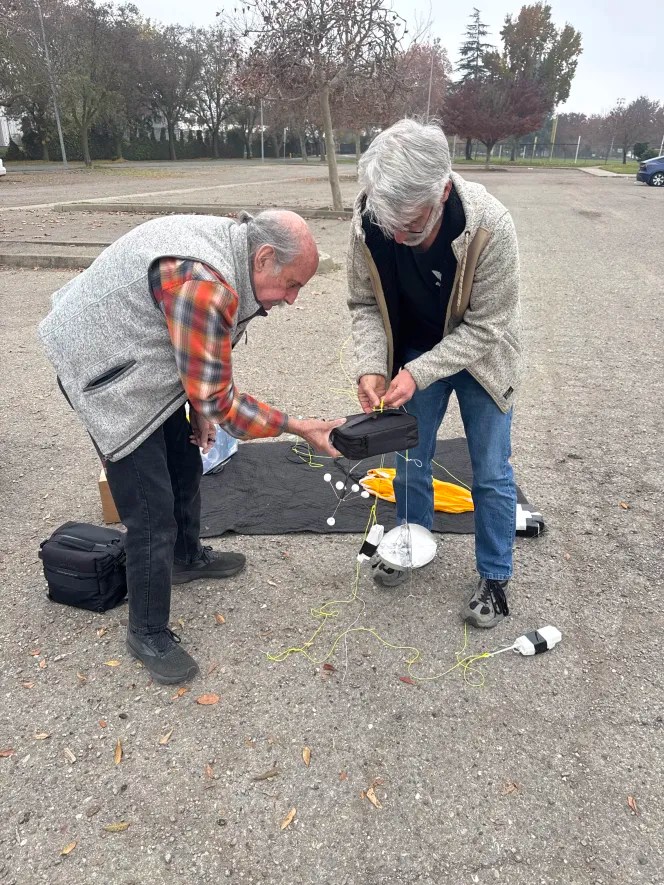
The initial coordinated launch time was supposed to be 10am, so Benjamin and I got to the park around 9:15, to find Martin waiting for us with all the HAB balloon hardware and filling tank. We detoured to a coffee shop when we heard NoiseBridge was running late. We started assembling our payloads on the table at a nearby coffee shop, which I am sure looked alarming to the other patrons.
Our intended payloads were:
– Meshtastic RAK wireless mini with GPS and a custom built 1/4 wave 915 mhz antenna
– Bryan’s repurposed RS41 Horus 4FSK tracker
– Crossband repeater
– Martin’s APRS tracker (using Kazu’s hardware)
– Wenet tracker and image transmitter
– Radar reflector
– Parachute
– dual cameras
NoiseBridge’s balloon was using a Meshtastic gps custom programmed tracker as their only payload. It was important to get our balloon up with a similarly programmed meshtastic node. I believe that Benjamin assisted NB with their initial programming, to ensure both balloons were on the same channel and settings.
After prepping our payloads and getting back to the launch site, we got our flight line ready, tying in all our payloads. While filling the balloon, and measuring neck lift, we got to about 1200 grams of lift, and then we noticed the hydrogen regulator was frozen up. A sign that we were losing (or lost) hydrogen somewhere, and quickly! By the time we noticed that, we were out of hydrogen. We did not have enough lift to cary all the intended payloads, so a quick cut of most non essential payloads was made. The cameras and their supporting batteries were removed, the crossband repeater was removed, and the wenet payload (which did not seem to be working anyways) was also removed. This left us with everything we really needed; a reliable tracking system – Bryan’s Horus radiosonde, Meshtastic tracker node, a super light APRS node, and the radar reflector and parachute. A quick check with NoiseBridge informed us that they were running further behind, but expected to launch within 20 to 30 minutes later, so we would still be in the air together. We launched the balloon into the light fog, and soon were receiving Horus locations, APRS reports, and meshtastic positions. All of which were also populating on the amateur.sondehub.org site.
We hung around long enough for a sondehub prediction based on our ascent rate and flight path. It was now predicted to land near Discovery Bay. We looked up restaurants near there and picked a pizza restaurant to meet at. Once there, as usual, we spent a little too much time waiting for the prediction to settle. But it was very erratic. At times the landing zone was supposed to be north of Discovery Bay, East of Discovery Bay, and then, finally South of Discovery Bay, near a large lake. Since our payload was so light, and the parachute was sized for a heavier payload, we thought the prediction may have been way off. But as usual, our balloon dropped like a rock. Probably the parachute getting pulled upside down by the heavy remnants of the balloon (more so than the light payloads).
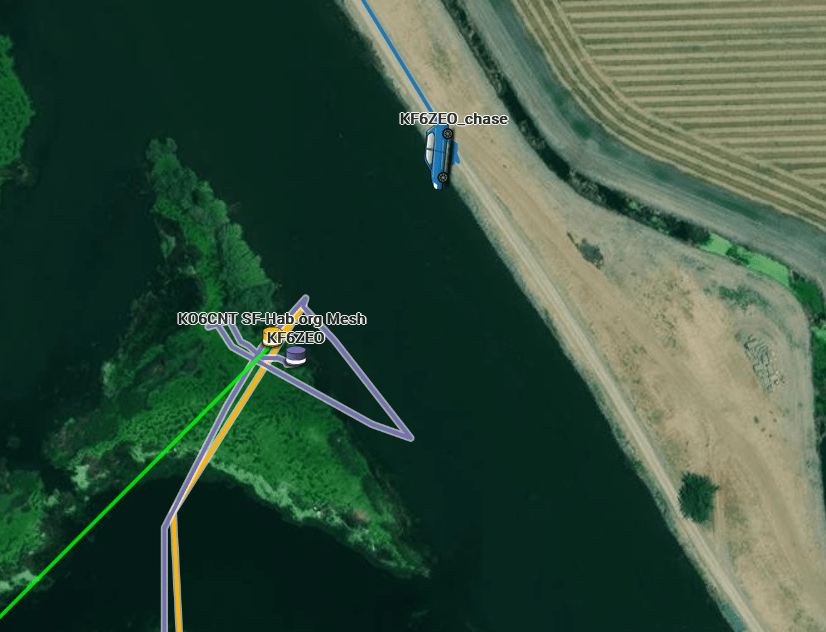
While Benjamin and I attempted to get to the East side of the lake, Bryan was attempting to get to the North end of the lake, which happened to be closer to the landing site. He ended up finding a levy that led him to within about 100 yards of the landing site … which happened to be on a small section of land in the middle of a river. Through his binoculars you could see sections of the balloon, and the fluorescent string attaching our payloads.


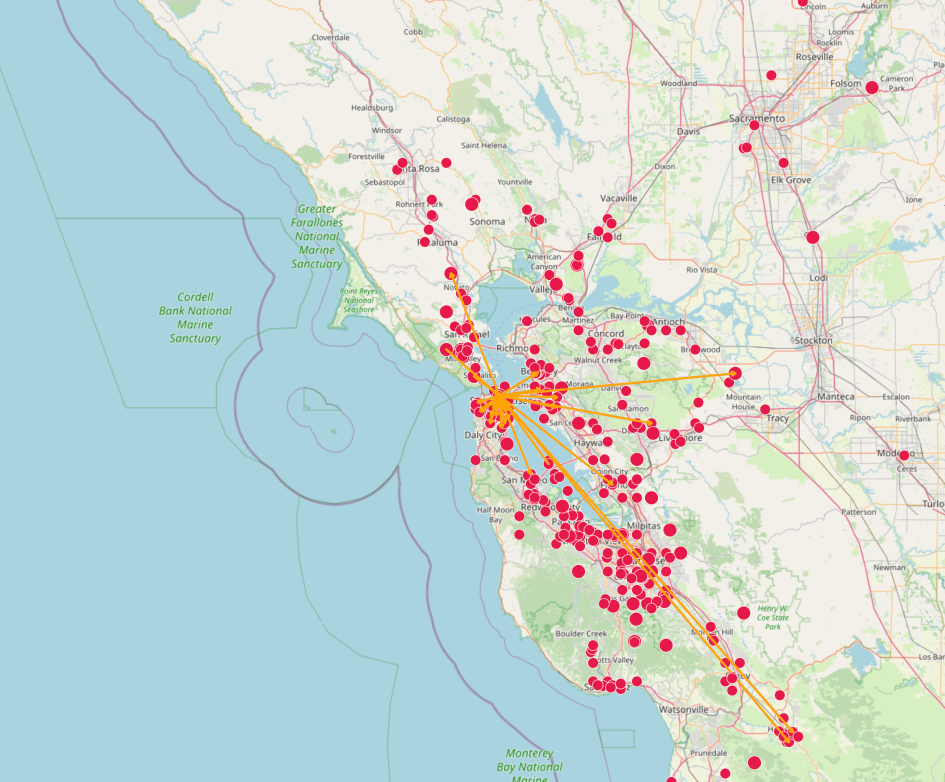




Although we were not able to recover this balloon, we still had a very successful flight. Benjamin’s custom meshtastic code worked perfectly. The furthest direct contact was in Los Angeles. There were reports from a cyclist deep in the Stanislaus forest, receiving messages from our balloon in an area there is normally zero meshtastic activity. APRS and Horus also worked very well, with Horus transmitting final RIP position reports. We believe our hydrogen leak might have been at or near the regulator. Though there may have been some leakage on the fill tube connector, where it meets the balloon valve. Martin is having his regulator checked out, and I am locating a replacement fill adapter for the end of the hose. Another item that Martin is working on is an electric cut off with nichrome wire, to detach the balloon. This will help by eliminating the dead weight of the balloon during descent, making descending speed more predictable, and possibly allowing us to select a better general landing zone.
NoiseBridge is newer to the balloon scene, and had their most successful launch yet. It sounds like during the launch setup, they tried to switch from MSL altitude, (the default altitude that meshtastic uses) to some other altitude measurement. Some say that MSL is about 60 feet off actual altitude… This is not really an issue for a balloon that is going to reach over 100,000 feet altitude. We think that because of this change, no altitude was being reported to meshtastic, or to sondehub. Because of this, sondehub grounded the location of the balloon in San Francisco, a mile or two from their launch site, even though the balloon actually went much further and higher. Perhaps through the mesh, their Lat and Lon position was still being transmitted. I am not sure, and don’t have details. We hope to do more collaborating with NoiseBridge, and more balloon to balloon experiments.
Sondehub tracking of our flight
 SF-HAB