Saturday, August 23, W6MRR-33 was launched. This was the second battery powered prototype, in an attempt to extend transmissions past solar generation “sunset”. Being very light weight with ~ 10 g for a typical payload doesn’t leave many options for batteries. Floating at ~ 40 K’, temperatures range from -50 C to -70 C. Usual battery chemistries don’t work well when cold. Most alkaline, NiMH, Li-ion, and LiFePO4 fail at these temperatures.
I found a lithium-polimer battery that was close but would need heating and battery protection with this battery: Grepow. Another promising chemistry is Silver-Zinc which would also need heating.
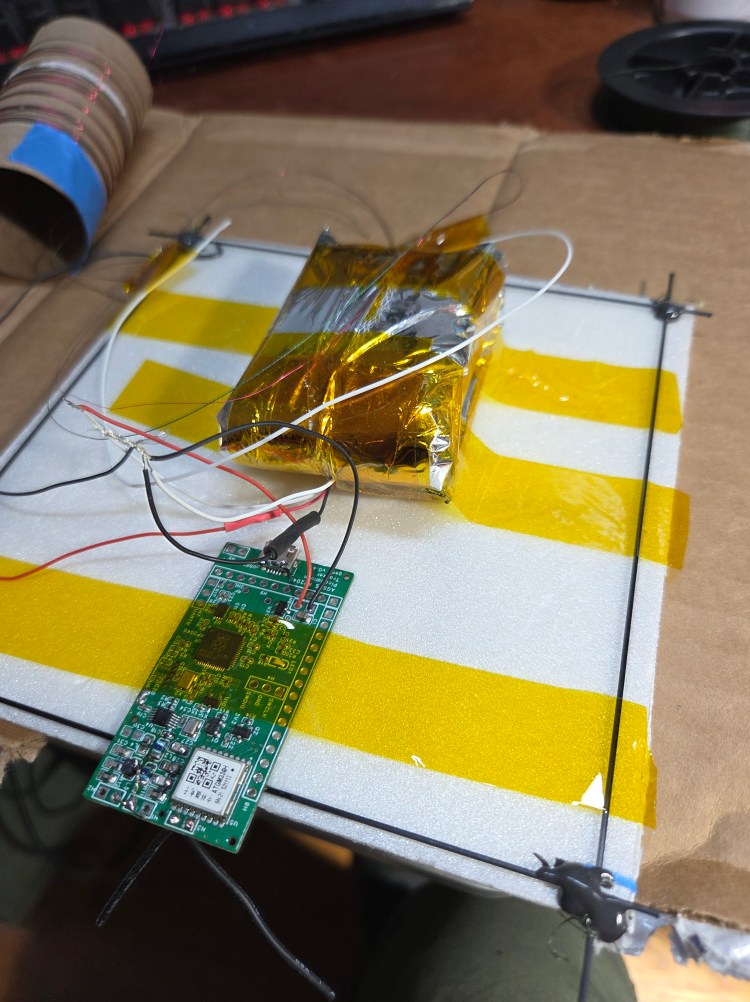
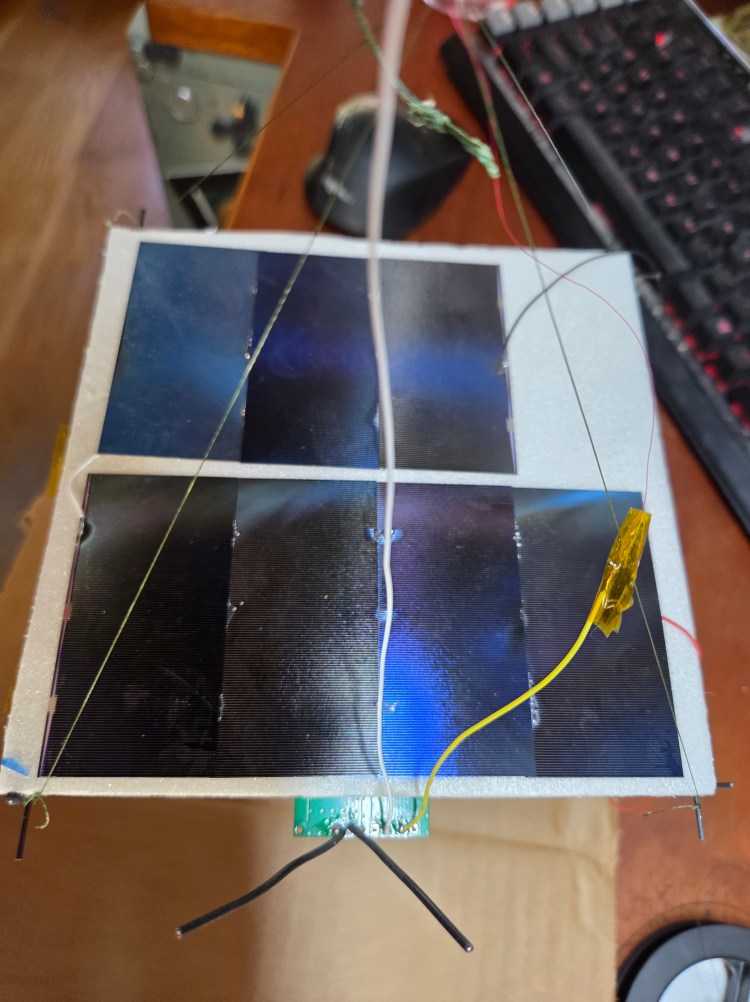
The Grepow battery has a few requirements that require a controller. That would add weight and complexity. I decided to go controllerless initially for proof of concept. I would use a fraction of the battery power for self heating via nichrome wire and insulate the whole thing. The battery, nichrome wire, Kazu’s GPS tracker and Sharp solar cells were connected in parallel. (The solar panel has a series schottky diode to isolate it at night).
The nichrome wire on W6MRR-32 had ~ 170 ohms resistance and the wire on W6MRR-33 has ~ 100 ohms. The big difference is the insulation. W6MRR-32 used aerogel wrapped in aluminized mylar. W6MRR-33 used Multi Layer Insulation (MLI).
During testing, the MLI insulated battery with temperature sensor, and nichrome heating wire was planted in dry ice ( -79 degrees C ). During the 24 hour test, the sensor never read below 0 C. So far, just one night into W6MRR-33 flight, the two picos are performing about the same. The LU-7AA.org site shows the solar angle associated with the report. While it probably isn’t that accurate, it does show transmissions sent while the solar angle was less than 12 degrees.
 SF-HAB